Banks lend against collateral. We lend against demand.
A bank underwrites your balance sheet, because a balance sheet is the only thing it can see. We can see something better: the forward order flow, and the routing decisions that fill your calendar with it. So the workholding standard, the probing hardware, and the capability upgrades are financed against routed work and repaid out of the jobs themselves — and when the work stops, the repayment stops with it.
Earned, not sold · Repaid per routed job · Paused when routing stops · Title passes at payoff
The collateral is the order flow.
A lender looking at a job shop sees used iron, a receivables ledger, and a backlog it cannot verify. We are the party generating the backlog. We know what is quoted, what is engineered, what is scheduled, and which shop the router is about to send it to — which means we can underwrite equipment against work instead of against your building.
That is also why the terms below are unusually plain. Every one of them exists to stop this from becoming the thing shops are right to fear: a piece of hardware that quietly becomes a reason you can never leave.
The workholding standard
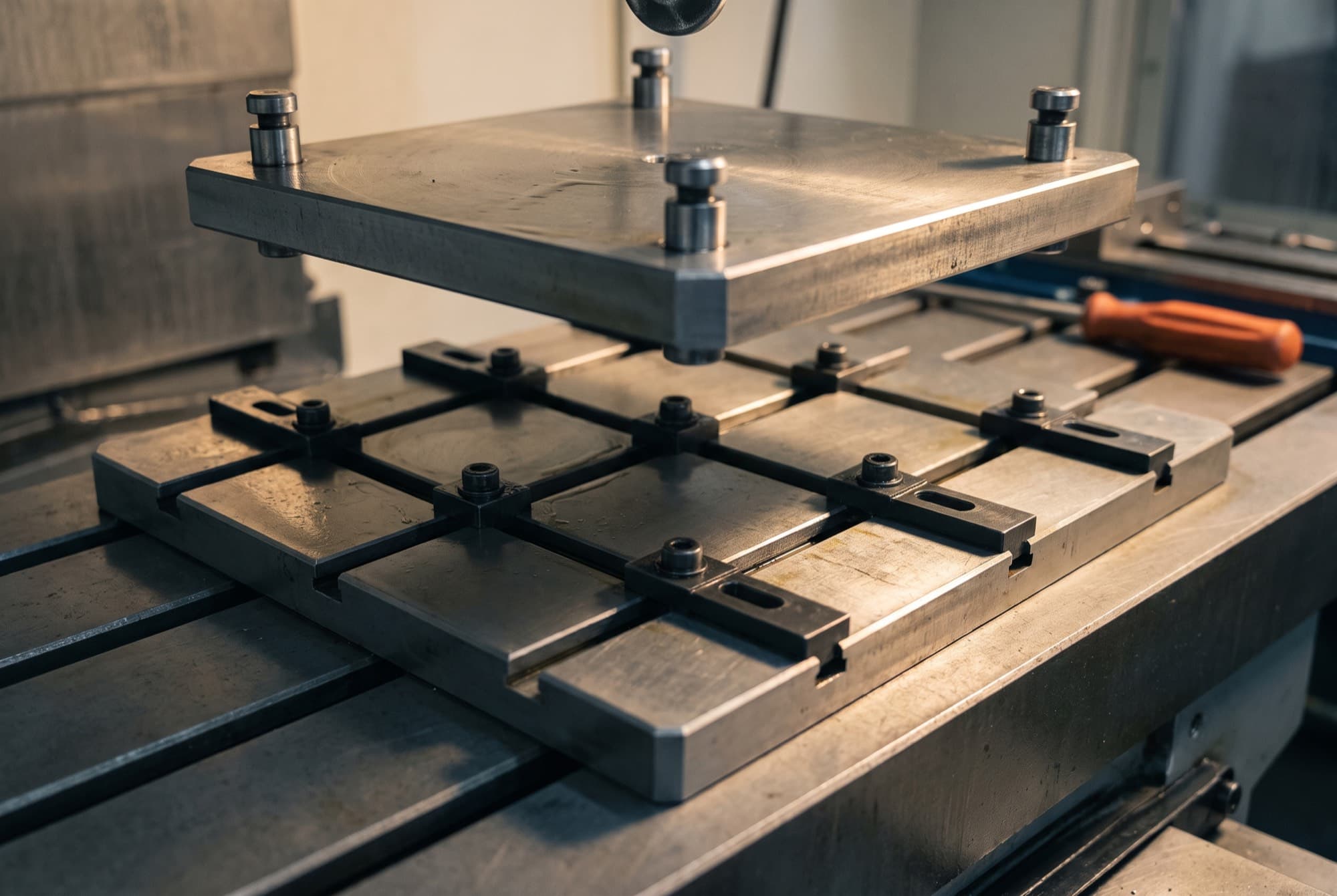
A single zero-point ecosystem, network-wide: base plate mounted to your machine table, pallets on the standard grid, pull studs and alignment hardware. Purchased by Praetore at network pricing and installed on your machines. Which ecosystem is a decision being made once, now, for every shop in the network — it is permanent for a decade, so it is being made like one.
Probing hardware
A spindle probe kit financed at cost for otherwise-strong shops without one. Probing is not optional in this network — every guarantee-critical dimension is verified by probe or inspection plan — so we would rather fund the probe than lose the shop.
Capability upgrades
Equipment that opens a tier of work the router can send you: the metrology that qualifies you for tight-tolerance packets, the fixturing that makes multi-part batches loadable. Financed the same way, against the work it unlocks.
Version 0.1 is not on this list because there is nothing to finance. No shop buys capital equipment to join. The only consumable is jaw stock, roughly $40 to $100 a set, shipped with your first job at cost if you prefer. Off-list vises get an adapter plate, free.
Four steps, in order.
Nothing here starts before you have been paid by us several times. Trust precedes iron, always — that ordering is the whole bootstrap doctrine of the company, not a courtesy.
- 01
Eligibility is earned, not applied for
The clock starts when you go live. Several completed paid jobs, first-pass yield at or above the network threshold, and a calendar-honesty score in good standing. The kit is a graduation, not a signup gift — which protects our capital and makes the standard mean something inside the network.
- 02
We buy the kit at network pricing
Praetore purchases the hardware directly at the pricing a whole network gets rather than the pricing one shop gets. You do not front the money, you do not carry the purchase order, and you do not negotiate with the vendor.
- 03
You repay from routed jobs
A fixed deduction per routed job, taken out of what we already owe you. There is no monthly payment that arrives whether or not the work did, no draw against a line of credit, and nothing to reconcile at the end of a quarter.
- 04
What the money costs
The balance is the kit at network pricing plus a stated administration amount, and that is the whole of it. No interest, no APR, no finance charge running in the background while you work it off. The figure is written on the addendum before you sign, and it does not move afterwards. This program is priced to get the standard onto machines rather than to earn a margin on lending — the same reason there is no fee anywhere else in this relationship.
- 05
The balance clears, and the program ends
There is no renewal, no rollover into a second kit you did not ask for, and no residual. The deductions stop when the balance reaches zero, and the hardware stops being ours on the same day. What that means contractually is the third term below.
Read these before anything else.
The first three are the clauses a shop owner should check first, so we put them on the public page instead of on page nine of an addendum. The fourth is there because two of the best things about this program are not clauses at all, and saying which is which is the point.
Summaries, not the instrument. The financing addendum to the Shop Production Agreement is the document that governs, and we send it before anything is installed.
The pause clause
If routing falls below the agreed floor for ninety days through no fault of yours, deductions pause. We do not collect on demand we failed to deliver. This is the clause that makes the sentence at the top of this page true rather than clever: if we lend against demand, then when the demand does not show up, the lending stops with it.
Exit: buy out the remainder, or send the hardware back
If you leave the network, you either buy out the balance on a straight-line basis or return the hardware. Those are the two paths, and they are the two paths in the addendum — which you get in full before anything is installed.
Title passes at payoff
When the balance clears, the hardware is yours outright — not leased back, not held against continued participation. Deliberately: ownership aligns care, and a base plate somebody owns gets treated better than a base plate somebody rents.
Two things here that are commitments, not clauses
First: shops are supply partners here, never a monetization target. No membership fees, no software charges, no take rate, no margin on a base plate. Second: the kit does not know which jobs came from us — it improves the runtime of everything that machine cuts, including the work you sold yourself.
Run the arithmetic on your own machines.
A generic worked example is a number built around somebody else's shop — their machines, their rates, their routing volume. It reads well and it tells you nothing about what this costs you.
So we run it against yours instead: hardware cost at network pricing, the per-job deduction, how the balance behaves at the routing volume your capability and calendar would actually earn, and where the title transfers. Every figure in it is about your shop, and every one of them is labelled for what it is.
Or write to hello@praetore.com. A person answers.
Tell us the machines you run and the work you take, and we will run the model against them: kit cost at network pricing, the per-job deduction, and how the repayment behaves at the routing volume you would actually see.
Every figure in it is yours, not a worked example built around somebody else’s shop.
What has to be true first.
None of this is a credit check. It is delivered history — yours — read out of the same record that decides your routing priority, computed the same way for every shop, and visible to you in full at all times.
The path from application to live- 01
Live in the network — qualification job passed and calibration jobs complete.
- 02
Several completed paid jobs on the board, so there is delivered history to underwrite against.
- 03
First-pass yield at or above the network threshold.
- 04
Calendar-honesty score in good standing: what you declare and what you deliver agree.
- 05
For the pallet tier, a repeatability runoff passed on the installed kit before batch and multi-part packets route to you.
Staying on version 0.1 indefinitely is a legitimate choice and costs you nothing up front. What it changes is which slice of the flow you see: the router knows which packets need pallet capability — multi-part batches, tight op-flip work — and which run on jaws. No shop is ever de-listed for running jaws.
The financing conversation happens after we have paid you.
Not before. Start where every shop starts: tell us what you run, and we will tell you within two business days whether the network fits your machines.