We send you the job, not the RFQ.
You did not buy a VMC to write estimates at nine at night. We engineer the job centrally and send a complete packet — verified program posted to your control, setup sheets, tool list, probe routines, inspection plan. You load, prove out, run, probe, ship. You are paid on delivery.
- No hardware purchase
- Version 0.1 of the standard runs on vises you own
- No fees, ever
- No membership, no software charge, no take rate
- Paid on delivery
- You invoice us; we carry the buyer's terms

Five things you stop doing.
Every item below is a task that exists in your shop today and will not exist for routed work. That is the whole trade: Praetore owns the engineering, the customer, the schedule, and the guarantee. You own the machines and the craft.
- 01
No quoting.
You never write another estimate for us. The price is fixed before the packet reaches your portal. There is no bid, no counter-bid, and nobody underbidding you on the same drawing an hour later. We do not send RFQs — not to you, not to anyone. That is the whole point of the company.
- 02
No programming.
Packets arrive verified: NC posted to your specific control, full material-removal simulation cleared including holder clearance, feeds and speeds proven. Your machinist loads, proves out, runs. If your controller is not in our post library, we commission the post and validate it on your machine — that is our work, not yours.
- 03
No sales.
Routed work is designed to be baseload. As order flow builds, your calendar should fill from it in the part families you are genuinely good at, because the router scores capability fit and available capacity before it scores anything else.
- 04
Paid on delivery.
You invoice Praetore, not the buyer. QuickPay terms are active from the day you go live: payment is due when the parts ship and you attest the acceptance criteria — not on a net-30 clock, and never contingent on when the buyer pays us. Praetore is the manufacturer of record and carries the buyer's payment terms so you never chase a stranger's accounts payable.
- 05
Your data works for you.
Every job you run produces a record: on-time, first-pass yield, setup versus estimate, probe results, calendar accuracy. That record is how you earn routing priority and financing eligibility. What it is never used for is written below, in the exact words we put in the agreement.
If you stop quoting, how does the number get set?
It is the first question any shop owner should ask, and a page that says “no quoting” without answering it is asking you to take the interesting part on faith. Four answers.
- 01
What the rate pays for
Spindle time, setup, and metrology — the things you actually do. The engineering, the coordination, and the utilization we gain by routing and batching are our side of the ledger, and that is where this company's margin comes from. It does not come from grinding the number on your side, which is a structural fact about the business model rather than a promise about our character.
- 02
Where the number is
On the packet, when it reaches your portal, before you tap accept. Rate, date, material, tool list, and setup sheets are on the same screen. You are never accepting a job and finding out afterwards what it pays.
- 03
Declining is a tap, not a demerit
Standing is on-time-in-full, first-pass yield, issue rate, responsiveness, and calendar honesty. A decline is none of those. The one thing it touches is the calendar-honesty index, because a calendar that reads open and a shop that says no are the same signal to the router — so change the calendar and the signal is clean again.
- 04
Rates are not renegotiated off your own data
Rate transparency and stability are the deal on the supply side, and the Data Covenant extends to pricing conduct. The record you build wins you routing priority and financing eligibility. It is never turned around and used to argue your rate down. That is commitment two below, word for word, and it is in the agreement.
The exact QuickPay language, and the rate schedule that applies to you, live in the Shop Production Agreement. Nothing on a web page substitutes for the contract, and we will send you the contract before you cut anything.
Four sentences, in the agreement.
Marketplaces taught this industry that giving up your numbers means having them used against you at the next negotiation. The four commitments below are reproduced word for word from the specification that governs how network data may be used, and incorporated into every shop agreement without alteration.
- 01
A shop’s data wins it work and underwrites it (routing priority, financing eligibility).
- 02
It is never used to negotiate that shop’s rates down.
- 03
Each shop sees its own standing in full, including exactly how routing priority is computed.
- 04
Public and aggregate uses (the Index, capability claims) are anonymized; no shop-identifiable data leaves the network without written consent.
We treat this as a product constraint rather than a policy. A covenant broken once is broken permanently, and the supply side of this company is not survivable without it.
Deliberately small, and none of it is a purchase.
The standard ships as software before it ships as iron. Version 0.1 is a soft-jaw specification on vises every shop already owns, and your first contact with it costs about a hundred dollars and arrives inside a paying job.
Vises you already own, fitted to our soft-jaw spec
6″ CLASS · APPROVED-MODEL LIST · JAW BLANKS 6061 OR 1018
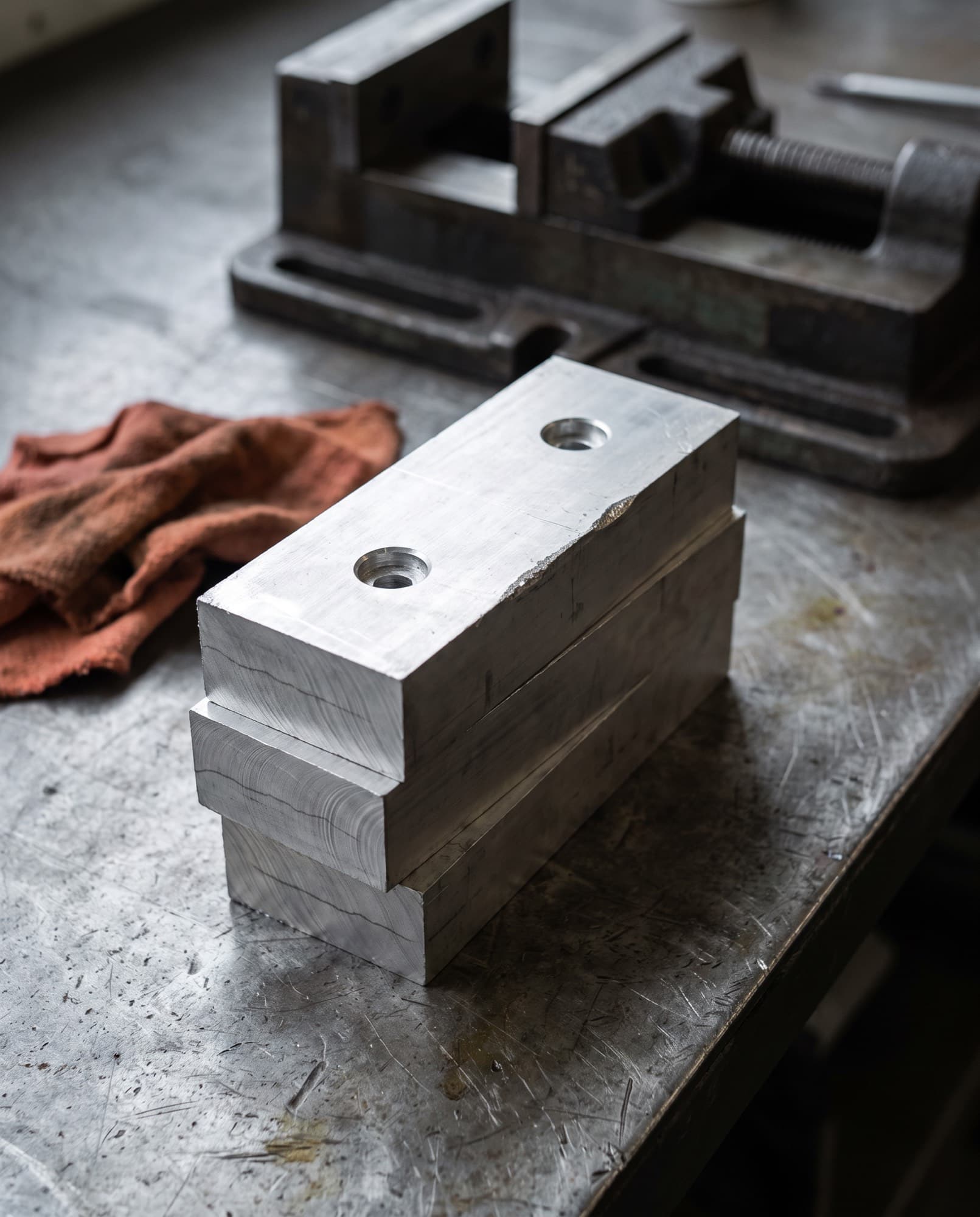
A 6-inch double-station or single vise from the approved-model list — common Kurt-pattern class. Jaw blanks in 6061 or 1018 per the packet spec, roughly $40 to $100 a set, or shipped with the job at cost. The jaw-machining programs arrive inside the packet, and cutting them from our program is simultaneously the fixture, the test protocol, and proof you can run a packet end to end. Off-list vises are not a disqualifier: we ship you an adapter plate at no cost.
Probing capability
SPINDLE PROBE · OR WILLING TO ADD ONE
A spindle probe, or the willingness to add one — we finance a probe kit at cost for otherwise-strong shops. The packet carries the probe routines: work-coordinate pickup, in-process gates, final verification with tolerance limits. Every guarantee-critical dimension is verified by probe or by inspection plan. Nothing critical is left uninspected, and nothing rests on “the operator checked it.”
Honest calendars
DECLARED CAPACITY · MEASURED AGAINST ACTUAL
Declared availability is the one input we cannot verify from outside your building, and the entire liquid-capacity promise rests on it. So we measure declared against actual and weight the router's trust accordingly. Chronic overdeclaration does not get you a lecture; it gets your calendar discounted. Declaring less than you have costs you work. Telling us the truth is simply the strategy that pays.
One 30-minute vise mapping
ONE TIME · PROBE ROUTINE · RECORDED IN YOUR PROFILE
Once, at onboarding, you run our vise-location probe routine and return the result. It gets recorded in your shop profile, and every packet we send afterwards references it. That is the entire installation procedure for version 0.1 of the standard.
No hardware purchase.
No fees, ever.
No membership dues, no software subscription, no take rate, no listing fee, no charge to be considered. Shops are supply partners in this company, not a revenue line. The zero-point pallet kit is a later, financed upgrade you earn into after you have been paid several times — never an entry requirement, and never a condition of routing.
How the equipment financing worksApplication to routing-eligible in two to three weeks.
Seven stages, each with evidence at the gate and a real duration attached. The clock assumes you engage; it starts the day you apply. Nothing in it costs you anything, and every cut you make along the way is paid.
Apply
DAY 0
The form at the bottom of this page. Machines and controls, travels, current workholding, probing and inspection equipment, certifications, and an honest backlog number.
Screen
DAY 0–2
We read it and answer. If there is no 3-axis VMC in the envelope class, no probing and no willingness to add it, or a backlog deep enough to make routing fiction, we tell you that plainly instead of leaving you on a list.
Floor visit
THE REAL GATE
About ninety minutes on your floor, against a written rubric: machine condition, metrology culture, chip and tool discipline, and a conversation about how you handle mistakes. Plenty of impressive websites do not survive the walk-through. Shops that hide scrap are disqualifying; shops that show you the scrap bin are the ones we want.
Profile & post validation
DAY 3–7
Machine profiles entered; post selected from the library, or commissioned if your control needs one. A standard validation program air-cuts on each machine class and you return the probe log. One step confirms the post, the probe, and portal fluency together. If we have to commission a post for your control, that adds days — and we tell you the number up front rather than letting the schedule quietly slip.
Qualification job
DAY 7–12
One packet, real material, shipped like a real job: the soft-jaw set plus a standard test coupon cut in those jaws. Jaw-critical dimensions and coupon features — bore, boss, pocket, thread, surface — probed in-machine and inspected per plan. You are paid a flat qualification fee for the run. We never ask a shop for free work; the relationship starts the way it will continue.
Calibration jobs
DAY 12–21
Two or three paid production jobs at low routing priority, watched closely: first-pass yield, setup time against estimate, communication, dates. All of it recorded, all of it visible to you.
Live
ROUTING ELIGIBLE
Visible to the router. Baseload-eligible. QuickPay terms active. The financing eligibility clock starts. Graduation requires complete acceptance criteria on every run, at least one on-time-in-full job, and no unresolved issues.
What your certifications unlock.
Certifications do not change your rate and they are not a membership tier. They are gates on specific classes of packet: each one makes a slice of the job flow eligible to route to you that otherwise cannot, no matter how good your machines are. None of the three is required to go live.
ITAR tier
Registration verified · facility and data handling reviewed · segregated-access training done
Eligibility for flagged packets — the export-controlled work that cannot route to a shop without this in place.
Tight-tolerance tier
CMM on site · gauge R&R evidence
Eligibility for Tight-class work: the packets whose tolerance bands we will not route to a shop that cannot demonstrate the measurement system behind them.
Pallet tier
Financed zero-point kit installed · repeatability runoff passed
Eligibility for batch and multi-part packets — the cross-customer batched work that only exists because loading is schedulable.
No certification at all is not a disqualifier — plenty of excellent shops have none, and the floor visit and the qualification job carry far more weight than a certificate does. Tell us on the form what you hold and what is in progress; it only ever adds eligibility.
Onboarding is your first taste of routed work.
If it does not feel like the brochure, the brochure is a lie and you should walk. So here is what we hold ourselves to before you have run a single part.
A stated response time, and a named human
Not a portal ticket queue and not an address at a company you have never met. One person, named, who answers.
Payment for every cut you make
Including the qualification run and every calibration job. There is no unpaid trial period in this network.
The packet-fault rule, in writing
If a shop has to ask a question to make the part, the packet failed — not the shop. When something goes wrong the first question is always what was missing or wrong in the packet, and the answer ships as a packet revision so the same failure cannot repeat anywhere in the network. If the qualification job fails, engineering determines packet fault or shop fault, and one retry is funded by whoever's fault it was. Packet faults are ours. We state that publicly because it builds more trust than passing does.
Standing that is a measurement, not a membership
Rolling on-time-in-full, first-pass yield, issue rate, and calendar honesty — computed the same way for every shop and published to you in full. Falling standing starts a conversation, not a de-listing. Removal is reserved for integrity failures; falsified inspection data is immediate and permanent.
Being early is worth something here.
The router reaches for the shops that are qualified when the work lands, and qualification is a three-week path you can only start by starting it. The shops on the standard first are the ones with standing history first, financing eligibility first, and first call on the part families they have already proven.
Every cut you make is paid, including the qualification run and every calibration job. There is nothing to buy and no fee at any stage. And your on-time rate, your yield and your standing are yours to see in full — the same numbers the router uses, computed the same way, with no version of them we keep to ourselves.
How performance is measuredTell us about your shop.
Ten minutes, no documents required yet. Answer the backlog question honestly — a deep book is not a rejection, it just changes when we would start routing. We screen inside two business days and reply either way.